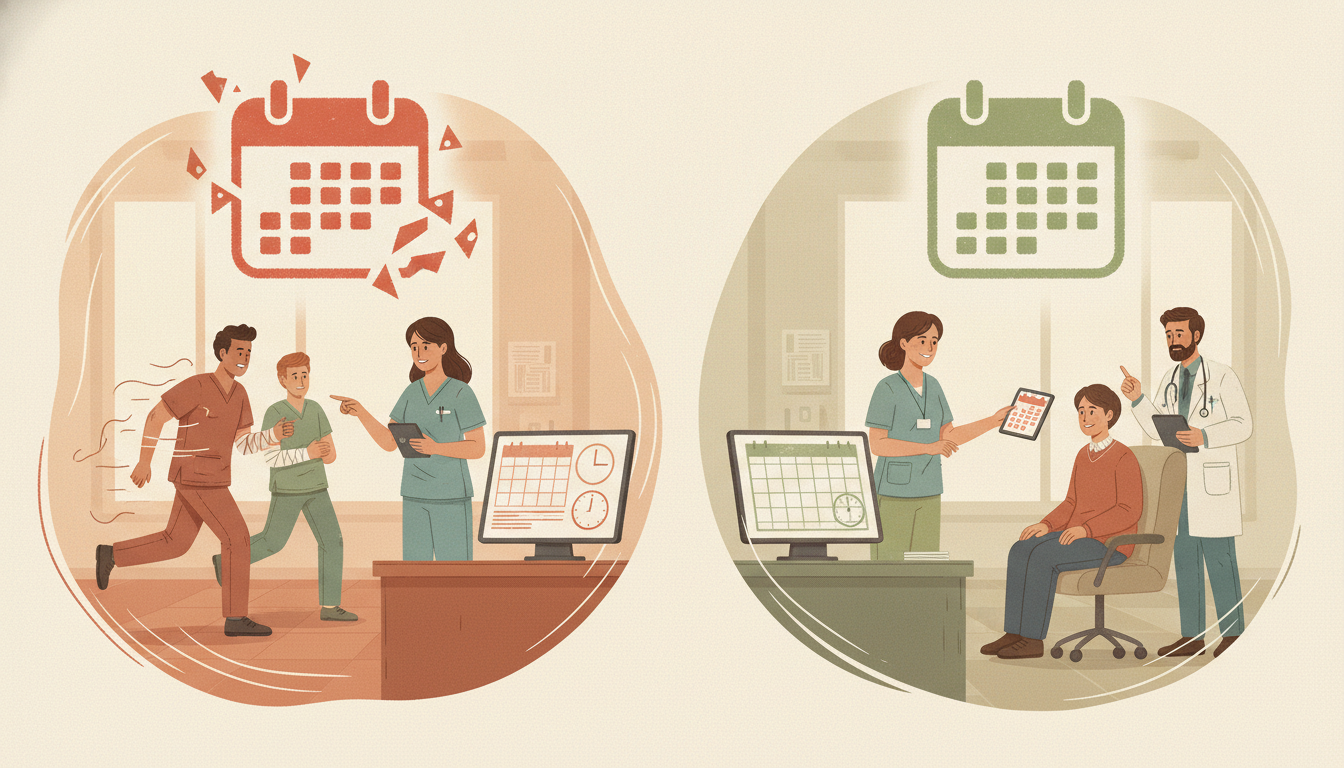
For medical and dental offices, effective appointment triage is not just about filling slots; it's about making critical decisions that impact patient health and practice flow. Differentiating between emergencies and routine requests requires clear protocols and skilled front-desk teams. This guide explores strategies for accurately assessing patient needs and managing your schedule to ensure urgent cases receive prompt attention while maintaining a predictable flow for routine care. Mastering this balance is essential for patient satisfaction, provider efficiency, and overall practice success.
Quick Overview: Triage Fundamentals
| Factor | Details |
|---|---|
| Purpose of Triage | |
| Key Triage Goal | |
| Initial Screening | |
| Emergency Indicators | |
| Routine Appointment Criteria | |
| Communication |
The operational problem
The challenge of managing a medical or dental practice schedule often boils down to a fundamental tension: how to accommodate the unpredictable nature of emergencies while maintaining the structure and predictability required for routine care. Without a clear system, front-desk teams can find themselves overwhelmed, making split-second decisions under pressure that can have significant consequences. Misidentifying an emergency as routine can delay critical care, potentially worsening patient conditions or leading to higher-acuity interventions later. Conversely, treating every urgent-sounding call as an emergency can disrupt the entire day, causing delays for scheduled patients, increasing wait times, and frustrating providers. This constant balancing act requires more than just good intentions; it demands defined protocols, ongoing training, and the right tools to empower staff to make consistent, informed triage decisions. The problem isn't just about fitting patients into slots; it's about making sure the right patients get into the right slots at the right time.
Daily Triage Tasks for Front Desk Teams
| Category | Specific Tasks | Time Saved / Week |
|---|---|---|
| Patient Intake & Initial Assessment |
| Track weekly |
| Consult Provider Protocols |
| Track weekly |
| Identify Urgent Red Flags |
| Track weekly |
| Educate Patients on Next Steps |
| Track weekly |
| Document Triage Decisions |
| Track weekly |
- Category
- Patient Intake & Initial Assessment
- Specific Tasks
- Ask specific, open-ended questions about symptoms, duration, and any alleviating or aggravating factors. Document all responses thoroughly.
- Time Saved / Week
- Track weekly
- Category
- Consult Provider Protocols
- Specific Tasks
- Refer to established guidelines from doctors or dentists for common conditions to determine urgency levels and appropriate scheduling pathways.
- Time Saved / Week
- Track weekly
- Category
- Identify Urgent Red Flags
- Specific Tasks
- Recognize critical symptoms (e.g., severe pain, bleeding, difficulty breathing) that necessitate immediate provider consultation or emergency room referral.
- Time Saved / Week
- Track weekly
- Category
- Educate Patients on Next Steps
- Specific Tasks
- Clearly explain why an appointment is being scheduled as emergency or routine, including expected wait times or alternative care instructions.
- Time Saved / Week
- Track weekly
- Category
- Document Triage Decisions
- Specific Tasks
- Record the rationale for scheduling decisions in the patient's chart, including who authorized any immediate appointment overrides.
- Time Saved / Week
- Track weekly
Emergency vs. Routine Appointment Triage
| Cost Factor | In-House Characteristic | SchedulingAppointment VA |
|---|---|---|
- In-house
- Our VA
- In-house
- Our VA
- In-house
- Our VA
- In-house
- Our VA
- In-house
- Our VA
- In-house
- Our VA
A clearer scheduling workflow
Implementing a structured triage process transforms a chaotic scheduling environment into a predictable and patient-centric system. When front-desk teams are trained with clear guidelines for identifying emergency versus routine cases, they gain confidence in their ability to make accurate assessments. This shift means that instead of guessing, they follow established protocols, asking precise questions that quickly narrow down the patient's condition. For emergencies, this might mean immediately flagging a provider or booking the earliest available slot, potentially in a designated emergency buffer. For routine appointments, it means scheduling within standard lead times, explaining the process, and managing patient expectations effectively. The practice moves from reactive problem-solving to proactive patient management, ensuring that urgent needs are met without constantly derailing the day's planned activities. This transformation leads to smoother operations, reduced stress for staff, and ultimately, better care delivery for all patients.
A day with the workflow in place
Consider Sarah, a front-desk operator at a busy dental clinic. Her day begins with a full schedule of routine cleanings and check-ups. At 9:15 AM, the phone rings. A patient reports sudden, severe tooth pain and swelling. Instead of panicking, Sarah calmly follows the clinic's triage protocol. She asks about the onset, intensity, and any associated symptoms. Based on the practice's guidelines, she identifies this as a potential emergency. She checks the scheduling system for the designated emergency slot or consults with the on-call dentist via secure messaging. Within minutes, she's able to offer the patient an appointment that afternoon, explaining the urgency and what to expect. Later, a call comes in for a routine follow-up cleaning. Sarah notes the request and schedules it for next month, aligning with the patient's preference and the clinic's availability, without disrupting today's urgent care. This systematic approach allows Sarah to handle diverse patient needs efficiently and without undue stress.
Indicators of Successful Triage Implementation
| Success Factor | How To Do It | Results You Get |
|---|---|---|
| Reduced Missed Emergencies | Fewer instances of urgent conditions being miscategorized as routine, leading to better patient outcomes. | Review this indicator weekly and adjust the workflow. |
| Optimized Provider Schedules | Fewer unexpected interruptions for routine appointments, allowing providers to focus on scheduled care. | Review this indicator weekly and adjust the workflow. |
| Improved Patient Satisfaction | Patients feel heard and know their concerns are being addressed appropriately, whether urgent or routine. | Review this indicator weekly and adjust the workflow. |
| Lower Staff Stress | Clear protocols reduce guesswork and pressure on front-desk teams, leading to a more efficient work environment. | Review this indicator weekly and adjust the workflow. |
- Success Factor
- Reduced Missed Emergencies
- How To Do It
- Fewer instances of urgent conditions being miscategorized as routine, leading to better patient outcomes.
- Results You Get
- Review this indicator weekly and adjust the workflow.
- Success Factor
- Optimized Provider Schedules
- How To Do It
- Fewer unexpected interruptions for routine appointments, allowing providers to focus on scheduled care.
- Results You Get
- Review this indicator weekly and adjust the workflow.
- Success Factor
- Improved Patient Satisfaction
- How To Do It
- Patients feel heard and know their concerns are being addressed appropriately, whether urgent or routine.
- Results You Get
- Review this indicator weekly and adjust the workflow.
- Success Factor
- Lower Staff Stress
- How To Do It
- Clear protocols reduce guesswork and pressure on front-desk teams, leading to a more efficient work environment.
- Results You Get
- Review this indicator weekly and adjust the workflow.
Common scheduling mistakes
One common mistake in appointment triage is relying too heavily on patient self-diagnosis or vague descriptions without asking clarifying questions. Patients might say 'it's an emergency' when they mean 'I want to be seen soon,' or they might understate a serious condition. Another pitfall is lacking clear, written protocols for common emergency scenarios, leaving front-desk staff to guess or make inconsistent decisions. Many practices also fail to build any buffer time into their schedules for unexpected urgent cases, leading to constant disruption when emergencies do arise. Overlooking the importance of training staff in active listening and empathetic communication during triage calls can also lead to patient frustration, even if the clinical decision is correct. Finally, not reviewing or updating triage protocols regularly, especially after critical incidents, means the system can become outdated and less effective over time, hindering overall practice efficiency.
A practical scheduling approach
Our approach to appointment scheduling for medical and dental practices centers on empowering your front-desk teams with intelligent tools and clear, actionable frameworks for triage. We understand that effective triage is not just about technology; it's about human judgment supported by a clear system. Our platform provides customizable intake forms that guide staff through critical questions, helping them quickly identify key indicators for emergency versus routine care. We offer features to easily flag urgent cases, communicate directly with clinical staff for rapid assessment, and manage emergency slots without overbooking or disrupting the entire schedule. This focus on practical, real-world application, combined with an intuitive interface, means your team can confidently make informed decisions, ensuring patients receive appropriate care promptly while maintaining an organized and efficient practice flow. We prioritize clear communication and adaptable processes, moving beyond generic scheduling to support your unique operational needs in patient triage. For Appointment Scheduling for Emergency Versus Routine Triage, the useful operating detail is in the handoff between a request and a confirmed time. Start by naming the decision that must be made, then record which information is required before a slot can be offered. A front-desk team can use a short intake sequence to separate a complete request from one that needs clarification. That sequence should make room for the customer's preferred day, the service or visit type, the people or resources involved, and any timing constraint that changes the choice of slot. It should also identify the point at which a staff member must review an exception instead of allowing the request to continue automatically. A practical schedule treats the calendar as an operating record, not just a list of appointments. When a change occurs, the person responsible for updating the record should also confirm the next communication. That may mean sending a revised time, explaining an arrival window, noting a preparation step, or offering a short list of alternatives. The purpose is not to make every situation identical. It is to make the ordinary path clear enough that unusual cases are visible. Teams can review a small set of weekly observations: requests that needed clarification, appointments changed after booking, open slots that could not be used, and follow-ups waiting for an owner. These observations help the business refine its rules without guessing. The same discipline supports a better customer conversation. Staff can explain what is known, what still needs confirmation, and when the customer should expect the next update. That language protects accuracy and avoids promises the calendar cannot support. It also gives operators a repeatable way to train new team members. In this way, appointment scheduling for emergency vs routine triage becomes a manageable workflow with clear ownership, visible exceptions, and a record of why each scheduling decision was made.
Sources
Related content
Frequently Asked Questions About Appointment Triage
How often should our triage protocols be reviewed?
What training is essential for front-desk staff in triage?
How can we handle patients who insist their routine issue is an emergency?
Optimize Your Practice's Triage Today
Ready to bring structure and efficiency to your appointment scheduling? Explore how our platform can support your front-desk team in making accurate, confident decisions for emergency and routine patient care. Improve patient outcomes and streamline your operations.
Book a Free Consultation →