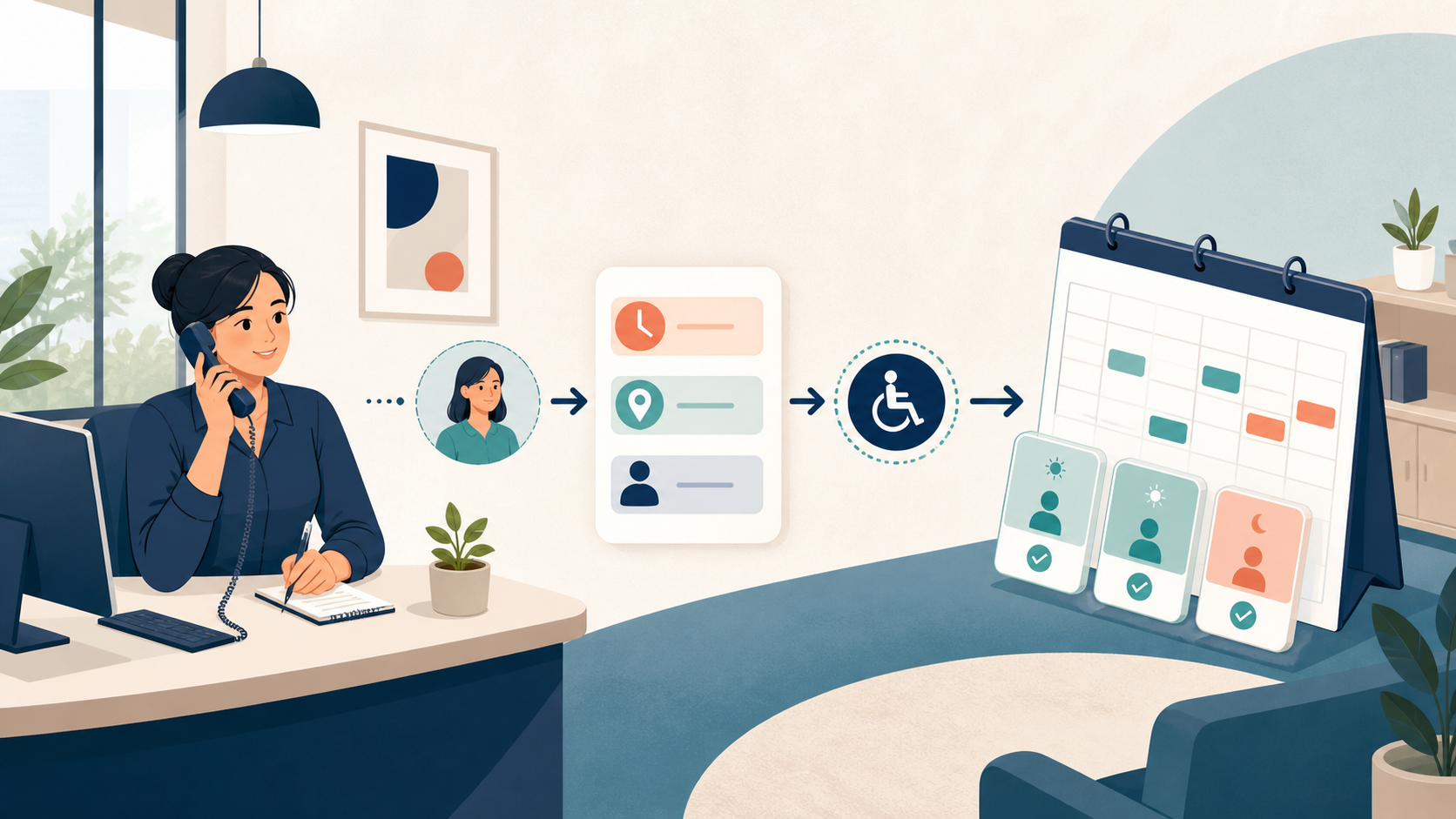
Accessibility begins before a slot is offered because the intake conversation determines whether the customer can participate in the process. This guide explains how appointment-based businesses can build a calmer, more accountable workflow around accessible phone intake. It connects the customer conversation to calendar rules, confirmation messages, exception handling, and a clear division between scheduling work and professional judgment.
Quick overview: accessible phone intake
| Factor | Details |
|---|---|
| Core decision | Define how the team handles accessible phone intake before a request reaches the calendar. |
| Customer need | A clear answer, realistic availability, and a confirmation that can be trusted. |
| Scheduling control | Use explicit ownership, permissions, holds, and escalation rules. |
| Common risk | A partial handoff or outdated availability creates rework and confusion. |
| Useful review | Study unresolved requests, calendar changes, and reasons for exceptions. |
| Role boundary | Scheduling staff route and document; qualified professionals make advice-based decisions. |
The operational cost of unmanaged accessible phone intake
Making Phone Intake More Accessible Before Scheduling requires more than a calendar link. The operating question is pace, preference, and communication access: who sees the request, what information is safe to collect, which availability is real, and how does the customer learn what happens next? A disciplined workflow makes pace, preference, and communication access visible at the moment a decision is made. That visibility protects the customer experience while giving the scheduling team a practical way to resolve exceptions without improvising. Accessibility begins before a slot is offered because the intake conversation determines whether the customer can participate in the process. In a busy appointment operation, this distinction matters because requests arrive with incomplete context, availability changes while people are talking, and a convenient slot for one person may create a conflict for someone else. Access
What a scheduling assistant handles for accessible phone intake
| Category | Specific Tasks | Time Saved / Week |
|---|---|---|
| Request intake |
| 3 hrs |
| Calendar control |
| 4 hrs |
| Customer updates |
| 3 hrs |
| Exception routing |
| 2 hrs |
| Quality review |
| 2 hrs |
- Category
- Request intake
- Specific Tasks
- Acknowledge the request and confirm the appointment type.
- Ask only approved questions.
- Record preferences and constraints.
- Time Saved / Week
- 3 hrs
- Category
- Calendar control
- Specific Tasks
- Check live availability.
- Apply holds or buffers according to policy.
- Prevent duplicate bookings.
- Time Saved / Week
- 4 hrs
- Category
- Customer updates
- Specific Tasks
- Offer realistic options.
- Send confirmations and changes.
- Explain the next step in plain language.
- Time Saved / Week
- 3 hrs
- Category
- Exception routing
- Specific Tasks
- Identify cases outside the scheduling role.
- Assign an owner.
- Track the promised follow-up.
- Time Saved / Week
- 2 hrs
- Category
- Quality review
- Specific Tasks
- Log unusual outcomes.
- Spot repeat failure points.
- Suggest workflow updates.
- Time Saved / Week
- 2 hrs
Ad hoc handling versus a managed accessible phone intake workflow
| Cost Factor | In-House Operating approach | SchedulingAppointment VA |
|---|---|---|
| Request visibility | Depends on memory and scattered messages | One record with a next action |
| Calendar accuracy | Checked differently by each person | Shared rules and current permissions |
| Exceptions | Resolved informally | Routed to a named owner |
| Customer updates | Sent when someone remembers | Triggered by defined events |
| Learning | Problems disappear after the booking | Patterns are reviewed and documented |
| Role boundaries | Easy to blur under pressure | Written escalation limits |
Request visibility
- In-house
- Depends on memory and scattered messages
- Our VA
- One record with a next action
Calendar accuracy
- In-house
- Checked differently by each person
- Our VA
- Shared rules and current permissions
Exceptions
- In-house
- Resolved informally
- Our VA
- Routed to a named owner
Customer updates
- In-house
- Sent when someone remembers
- Our VA
- Triggered by defined events
Learning
- In-house
- Problems disappear after the booking
- Our VA
- Patterns are reviewed and documented
Role boundaries
- In-house
- Easy to blur under pressure
- Our VA
- Written escalation limits
How a scheduling workflow changes accessible phone intake
ible phone intake should therefore be designed as a sequence of small decisions: acknowledge the request, confirm the constraints, offer suitable options, record the outcome, and assign any remaining work. Start by naming the boundary of the scheduling role. A scheduling assistant can explain available appointment types, ask approved intake questions, check the calendar, place a booking, send a confirmation, and document an unresolved issue. The assistant should not invent clinical, legal, technical, or service advice. When a request crosses that boundary, the record should carry the customer's stated need and a clear escalation owner rather than a guess. This keeps the calendar useful without turning scheduling into unsupervised decision-making. The next design choice is the handoff record. It should be brief enough to use during a live conversation and complete enough for the next person to act. Record the requested
A day of handling accessible phone intake
appointment type, preferred windows, relevant access or communication preference, constraints that affect the slot, and the promised next step. Avoid copying unnecessary personal detail. For accessible phone intake, the record is especially valuable when the calendar changes after the first contact because it lets another team member continue without asking the customer to repeat the entire story. A reliable team also tests the workflow at the edges. Walk through a request that arrives outside the main coverage window, a request with no immediate availability, a change made after confirmation, and a customer who does not respond to a reminder. Decide in advance which message is sent, how long a tentative hold lasts, who reviews the exception, and when the request is considered closed. These tests reveal hidden dependencies that a happy-path booking never exposes. Measurement should support learning rather than reward bu
How to make accessible phone intake dependable
| Success Factor | How To Do It | Results You Get |
|---|---|---|
| Name the trigger | Define the event that starts the accessible phone intake workflow and who owns the first response. | Fewer requests sit unseen. |
| Protect the calendar | Use permissions, buffers, holds, and conflict checks that match the real operation. | Availability is easier to trust. |
| Write the handoff | Capture the request, constraints, status, next action, and due point in one record. | Customers do not have to repeat themselves. |
| Review exceptions | Look for recurring failure patterns and update the rule or training material. | The workflow improves over time. |
- Success Factor
- Name the trigger
- How To Do It
- Define the event that starts the accessible phone intake workflow and who owns the first response.
- Results You Get
- Fewer requests sit unseen.
- Success Factor
- Protect the calendar
- How To Do It
- Use permissions, buffers, holds, and conflict checks that match the real operation.
- Results You Get
- Availability is easier to trust.
- Success Factor
- Write the handoff
- How To Do It
- Capture the request, constraints, status, next action, and due point in one record.
- Results You Get
- Customers do not have to repeat themselves.
- Success Factor
- Review exceptions
- How To Do It
- Look for recurring failure patterns and update the rule or training material.
- Results You Get
- The workflow improves over time.
Common mistakes in accessible phone intake
sywork. Review the age of unassigned requests, the share of bookings changed after confirmation, the number of conflicts caught before the appointment, and the reasons customers abandon a proposed slot. Compare those signals by channel or appointment type when the volume supports it. A metric is useful when it leads to a specific operating adjustment, such as changing a reminder sequence, clarifying an intake question, or adding a protected buffer. For a virtual assistant or distributed front desk, documentation is the bridge between consistency and judgment. Give the operator a current availability map, approved language for uncertainty, examples of valid escalations, and a way to flag a rule that no longer matches reality. Review the guide when services, staffing, locations, or calendar rules change. The goal is not to script every sentence; it is to make the important decisions repeatable and the unusual decisions v
The SchedulingAppointment difference
isible. Customers notice the quality of scheduling through small moments: whether the person understands the request, whether the offered time is actually available, whether the confirmation includes the details they need, and whether a change receives a prompt explanation. Those moments are operational signals. When the team treats accessible phone intake as a managed workflow, it can spend less time repairing avoidable errors and more time helping people reach the right appointment. A practical rollout can begin with one appointment type and one coverage window. Map the current path, mark where information is duplicated, set the escalation boundary, and observe a small set of real requests. Then adjust the script, calendar permissions, and follow-up ownership before expanding. This sequence creates evidence without forcing the entire operation to change at once, and it makes it easier to explain why a new rule exists.
Sources
Related content
Common questions answered
Can a virtual assistant manage accessible phone intake?
What should be documented after the first contact?
How do we know whether the workflow is working?
Should every unusual request be escalated?
Bring more control to accessible phone intake
If accessible phone intake is creating repeated interruptions, map the request path and identify the first missing rule. A scheduling assistant can help acknowledge requests, protect the calendar, document constraints, and keep follow-up visible while your qualified team handles decisions that belong outside the front desk.
Book a Free Consultation →